ChatGPT Ads for Hotels: What They Cost, How They Work, and What to Check Before You Launch

ChatGPT Ads reached a $1 billion annualized revenue run rate in under 200 days (OpenAI, Aug 2026), that makes ChatGPT Ads for hotels a channel worth pricing out now. OpenAI started testing ads with a U.S. pilot earlier this year, and they are now sold in over 60 countries. On September 24, the rollout also reached Asia, becoming available in Thailand, Indonesia, Malaysia, Singapore, Vietnam, the Philippines and Taiwan (OpenAI, Sep 2026).
Hotels have a clear reason to pay attention. 40% of travelers already use AI to plan trips (HotelWorld AI / Bain, 2026). A traveler who asks ChatGPT for a quiet hotel near the convention center with an airport transfer shows more booking intent than someone scrolling a feed.
If you’re a hotel GMs or a Director of Sales and Marketing who’s deciding whether ChatGPT Ads for hotels deserve a line in the budget, we’ll cover below what the format looks like, the costs, how the strategy fits alongside Google and Meta, and red flags to watch for when an agency pitches it to you.
What Do ChatGPT Ads Actually Look Like?
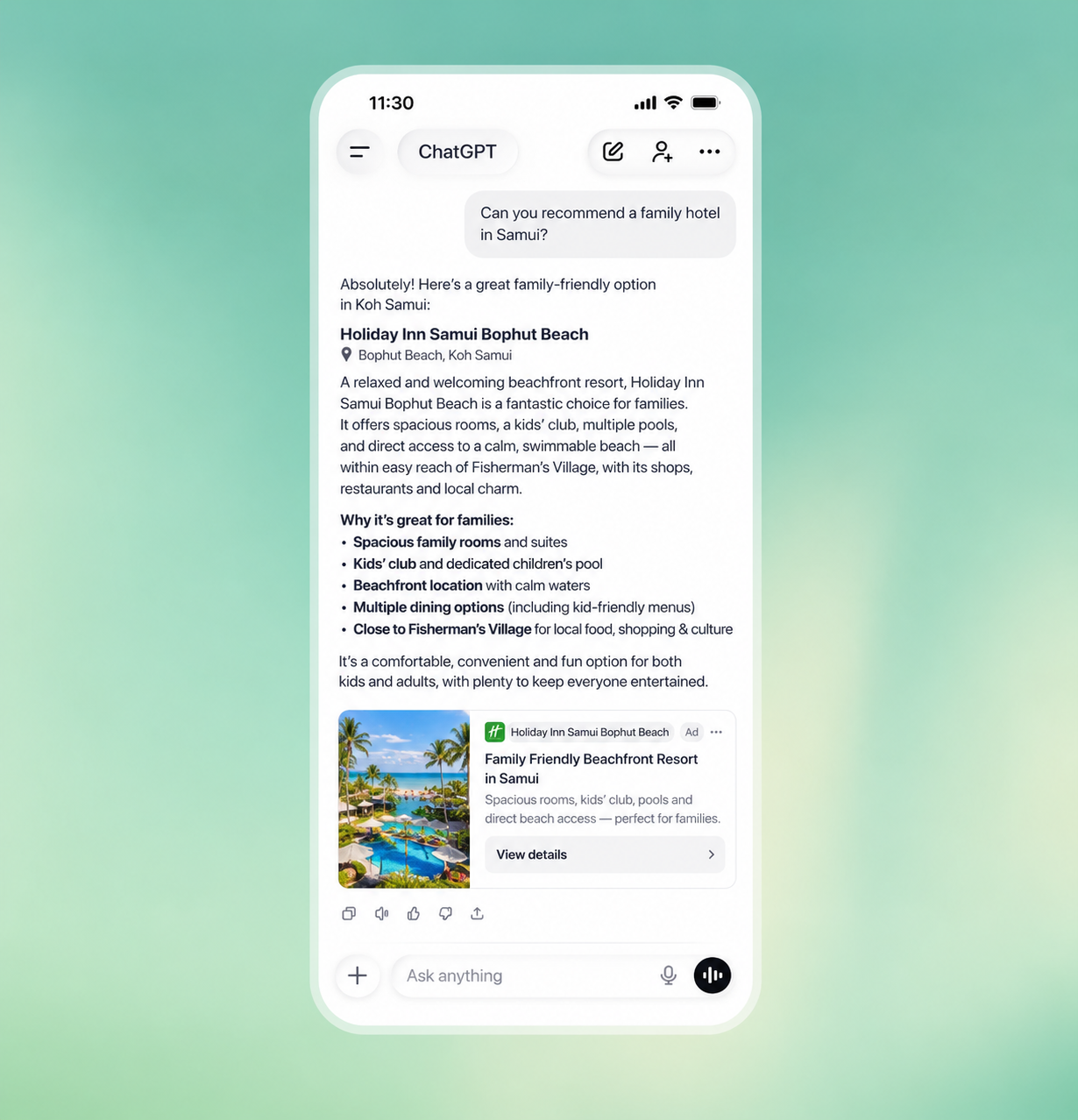
A ChatGPT ad is a sponsored card that appears below the answer, after ChatGPT finishes responding. It is labeled Sponsored and visually separated from the response (OpenAI Help Center, 2026). Only logged-in users on the Free and Go plans see ads. Plus, Pro and Business accounts stay ad-free. OpenAI also states that ads have no influence on the answer itself, which is a key distinction.
A ChatGPT ad puts your property directly underneath the answers. Whether ChatGPT names your hotel in the answer is still decided by organic signals: structured data, reviews, business listings, and content that answers the guest's question. This is something your property will still need to scale through GEO.
How Does ChatGPT Ads Targeting Work Without Keywords?
ChatGPT Ads does not use traditional keyword lists, advertisers write context hints instead: descriptions of the conversations, topics or phrases where their property is relevant. OpenAI notes that hints steer ad matching without acting as exact-match keywords, and they do not guarantee that an ad appears in a specific conversation. At the time of writing, Ads Manager offers geo-targeting but not demographic targeting.
For a hotel, this rewards specificity. A context hint of "hotels in Bangkok" competes with every property in the city. A hint like "conference travelers needing a hotel near the Queen Sirikit National Convention Center with early check-in" describes a real guest with a real booking need.
The properties that get the most from this format will be the ones that already know their demand segments: the corporate group booking a block of rooms, the family booking a school-holiday villa, the extended-stay guest on a two-week project. We recommend mapping one ad group to each.
How Much Do ChatGPT Ads Cost for Hotels?
Due to the dynamic nature of the platform during the initial launch phase, pricing has moved fast and the platform remains dynamic at this time.
At the February launch, access was limited to enterprise partners with a reported $200,000 minimum commitment. That minimum fell to $50,000 in April and was removed entirely when the self-serve Ads Manager opened to all U.S. businesses on May 5, 2026 (Topify, 2026; WebFX, 2026).
Current benchmarks:
CPM: OpenAI's default maximum bid is $60 per 1,000 impressions. Observed clearing rates have settled closer to $25-45 as inventory has grown (Topify, 2026).
CPC: OpenAI recommends a starting maximum bid of $3-5 per click. The auction is relevance-weighted and second-price, so you often pay less than your bid (OpenAI Help Center, 2026).
Conversions: Conversion-optimized bidding is available for accounts with tracking set up through the OpenAI Pixel or Conversions API.
There is no official cost per direct booking benchmark for ChatGPT Ads for hotels yet. The closest data is retail. Criteo reports that traffic referred from AI platforms like ChatGPT converts at about 1.5 times the rate of other referral channels across its U.S. clients (Criteo, 2026). That is retail data, not hospitality data, so it shows direction only. Treat the first 60-90 days as a defined test, and judge it on cost per direct booking, not CPM.
Is the Early-Mover Window Still Open?
Partly: Tens of thousands of advertisers already run ads on ChatGPT (OpenAI, Aug 2026), so the auction is no longer empty.
Hotel-specific competition still looks thin in most destinations, particularly in markets that opened in the last few weeks. Ad platforms have often become more expensive as more advertisers arrive. ChatGPT CPMs have moved the other way since launch, falling from the $60 default as inventory grew (Topify, 2026), so future pricing is an open question.
Properties that learn which guest conversations convert now will set their future bids on real data. Properties that wait will be learning through a more crowded auction.
Where Should ChatGPT Ads Sit in a Hotel's Budget?
ChatGPT Ads work alongside Google. Google captures travelers who already know what they want and are comparing rates. ChatGPT reaches travelers who are still deciding and want a recommendation before they search for a price.
For properties with a limited budget, the priority order is:
Google Hotel Ads and branded search: Protect the direct booking intent you already have.
Google non-branded search for high-intent destination terms.
Meta retargeting for website visitors who left without booking.
ChatGPT Ads as a separately budgeted test, once conversion tracking is in place.
What Should You Check Before Launching a ChatGPT Ads Campaign?
Market availability: OpenAI publishes a country-by-country list of where self-serve Ads Manager is live, and the business that advertises and is billed must be based in a listed country. Check this before planning launch dates, particularly for multi-market groups.
Conversion tracking: Connect the OpenAI Pixel or Conversions API to your booking engine before you spend the first dollar. Without it, you are buying clicks you cannot tie to revenue.
Landing pages: Send traffic to a page that answers the conversation the ad appeared in. A traveler asking about family suites should land on family suites with a live rate, not the homepage.
Account ownership: The Ads Manager account should be in your property's name, with your agency granted access. The same rule applies to Google Ads.
What Are the Red Flags When an Agency Pitches ChatGPT Ads?
Watch for claims that paid placement gets your hotel recommended in the answer: OpenAI states that ads do not influence responses, so an agency that says otherwise either misunderstands the platform or is overselling it.
Check the pricing terms: If a proposal quotes minimum spends or launch terms from early 2026, the agency is working from secondhand information on a platform that changes fast.
Look at how results are reported: If reporting is built on impressions and click-through rate, ask what cost per direct booking the campaign targets and how it will be measured.
Be wary of guaranteed results: Ads Manager is still in beta, and hotel-specific results data is thin. An agency that promises an outcome is guessing.
Frequently Asked Questions
Are ChatGPT Ads available for hotels outside the US?
Yes, ChatGPT Ads are available in more than 60 countries, including Thailand, Indonesia, Malaysia, Singapore, Vietnam, the Philippines and Taiwan since September 24, 2026 (OpenAI, Sep 2026). Self-serve Ads Manager runs on a narrower country list, so check OpenAI's Ads Manager Availability page, which changes often.
How much does it cost to advertise a hotel on ChatGPT?
There is no minimum commitment. The minimum campaign budget is $25/day in the U.S. and varies by currency (OpenAI Help Center, 2026). CPC campaigns typically start at $3-5 per click, and CPM campaigns carry a $60 default maximum bid, with actual clearing rates often lower. Size your test budget on the number of direct bookings you need to read results with confidence, not on the platform's pricing.
Can a hotel pay to be recommended in ChatGPT's answer?
No. Ads appear below the answer, and OpenAI states they do not influence it (OpenAI Help Center, 2026). Being named in the answer depends on organic visibility, which is where GEO comes in.
Should hotels run ChatGPT Ads in-house or through an agency?
Either works if conversion tracking is set up properly and results are judged on cost per direct booking. An agency adds the most value where context hints need mapping to guest segments, and where ChatGPT spend needs coordinating with Google, Meta and GEO work.
Are ChatGPT Ads Worth Testing for Your Property?
ChatGPT Ads for hotels give properties a way to appear at the moment a traveler asks for a recommendation. That has real value. The channel is also new, still in beta, and priced through an auction that is likely to get more competitive as more advertisers join.
The properties that win here will treat it like any new channel: a defined test, tracked to direct bookings, and run alongside the organic work that gets them named in the answer itself.
Zanobe is running ChatGPT Ads for hotel clients as part of our AI search advertising service, with every campaign tracked to direct bookings from day one and coordinated with the GEO work that earns organic recommendations.
If you want to know whether ChatGPT Ads make sense for your property, and how they would sit alongside your Google and GEO strategy, book a call and tell us where you are starting from.
[ Schedule a Call ]
Sources
OpenAI, Ads in ChatGPT: The Basics (Help Center), 2026
OpenAI, Daily Budgets (Help Center), 2026
OpenAI, Ads Manager Availability (Help Center), 2026
OpenAI, A Milestone in Expanding Access to AI, August 2026
OpenAI, ChatGPT Ads Expands to Southeast Asia and Taiwan, September 2026
Topify, ChatGPT Ads Cost in 2026: CPM, CPC & What You Actually Pay, July 2026
WebFX, ChatGPT Ads Manager: How OpenAI's Self-Serve Platform Works and Who Should Test It, August 2026
HotelWorld AI / Bain, World's Best at AI Index, February 2026
Criteo, Criteo Joins OpenAI Advertising Pilot in ChatGPT, March 2026